Tuesday, December 9, 2014

Big Night and Avarice

    Big Night is a drama, comedy, and romance all at once that stars and is directed by Stanley Tucci. The film came out in 1996 and has stayed relatively silent ever since, which is a shame because it’s brilliant on all technical scales and would be a prime sister piece to Rebecca DeYoung’s Glittering Vices, more specifically her chapter on avarice.
    The film revolves around the life of two brothers, Stanley Tucci and Tony Shalhoub, as they try to make it in America via the Italian restaurant business. Trouble emerges as the other Italian restaurant less than a mile away from the brothers’ continually brings in far more business. Not too long after the brothers realize there’s no hope left, the owner, played by Ian Holm, of the more popular restaurant comes over to try and “help” the others. This is where the avarice comes in. Holm begins by genuinely telling one of the brothers, Tucci, that there is always room over at his restaurant for the two of them. Tucci says very little when asked and states that he has to speak with his brother, who tends to be a hothead a lot of the time. Holm already knows that his brother will say no so he commits the act of true avarice not too long after that meeting. Holm takes advantage of Tucci as well as Shalhoub by claiming he knows every star there is, especially Louis Prima. Holm goes on to say that Mr. Prima was going to come to his restaurant later in the week, but he wouldn’t mind allowing the brothers to have him instead in order to gain popularity. Obviously, Louis Prima was never scheduled to go anywhere, but the brothers believe him and throw an extravagant party that just ends in despair. By committing such an act Holm displays that he not only has the most successful restaurant and desires the brothers, but if he can’t have them than no one can. That fits Rebecca deYoung’s definition of avarice perfectly. Ian Holm just takes every ounce of what he’s got and puts it all towards greediness against some misfortunate competition.
    My post may not seem like much since it’s nearly a summary, but Holm’s act takes a lot of malicious buildup and an immense amount of coldheartedness that it truly is something to be discussed, and without a retelling it wouldn't seem complete. On one last note, I adored this film and wish more than just four or five people had showed up to it.


Gojira and Wrath

    Once again this post will revolve around one of the Seven Deadly Sins discussed in my philosophy class. Gojira, directed by IshirĂ´ Honda from 1954 isn't a film one would associate wrath to because it perhaps it's too simple a premise, but I find it interesting. As you know, given what the movie is, it’s a little ridiculous in several ways, from visual effects to campiness to acting, it’s all over the top. Some of things that I will point will certainly seem laughable, but there’s no denying that those laughable examples represent the vice of wrath.
    All throughout Rebecca DeYoung’s chapter on anger in her book, Glittering Vices she explains time and time again that anger is perfectly okay and normal to have. She uses God as an example to prove that anger has a place in this world, but she also says that only the right kind of anger has a place in this world. To further elaborate on such, DeYoung says if one has anger pertaining to a lack of justice, say your friend gets killed, then that is okay. What’s not okay are things such as freaking out over somebody spilling a drink on something, or going out and killing someone because you lost money on the horse race. In the film Gojira the creature, named Godzilla by Americans, displays loads of these unjustified anger outbursts. The first one is when Godzilla wakes up, the reason for the entire film. In the original he wakes up from the bottom of the ocean because too much nuclear activity has disturbed his slumber, and instead of solving things in a civil manner by sitting down and discussing things, he instead destroys all of Tokyo with no mercy. Granted Godzilla is not a civil human being, but still he’s being a gigantic baby. Now, even though the people of Tokyo caused the radioactivity levels to soar, they have every right to get mad at Godzilla because they did not know he was there trying to nap. A second example, although not as big as my previous one, can certainly be categorized as wrath. As Godzilla destroys Tokyo, tons of things are happening around him such as evacuations, and as a train full of people is trying to leave Godzilla steps in front of them, hurting Godzilla’s foot and causing him to rage some more. Godzilla just doesn’t get how rage is supposed to work, just not one bit.
    Yes, these seem ridiculous to be pointing out, but they most certainly are true and are perfect displays of wrath.


A Letter to Momo and Sloth

    A Letter to Momo directed by Hiroyuki Okiura is a Japanese animated film with a style similar to that of Hayao Miyazaki of Studio Ghibli. A style in which mystical worlds and a true sense of fantasy prevail over everything else. The story follows the life of Momo as she travels with her mom to live with her grandparents in a smaller town. The reason for the move is due to the rather sudden death of Momo's father. Amongst the heartache, Momo and her father have strong interaction with the vice of sloth in various ways. 
    In my Intro to Philosophy class we are reading Rebecca DeYoung's Glittering Vices. DeYoung defines sloth as indeed having to do with laziness, but also as being extremely busy to the point of having “no free time” to do anything other than busy work. Towards the end of A Letter to Momo one of the last interactions between Momo and her father is displayed in a rather depressing sloth-filled manner. Momo had gone out of her way to score some very difficult to acquire tickets for he dad, and when she giddily presents them to him he tells her he’s too busy. Momo, heartbroken by her father’s slothful action takes refuge in her room and rather than being the better person, she falls back on the actions performed by her father. However, instead of Momo being slothful in the sense that her father was, she initially takes more to the renown definition of sloth. She stays cooped up in her room not wanting anything to do with anyone. On behalf of Momo’s father’s action, she becomes subdued and acts in a lazy manner by not applying the effort she’s capable of in order to fix things. It’s not until Momo’s father dies and the move takes place that Momo acts slothful in the way her father did. As her mother, and even her grandparents try to get her to interact with the other people of the new town, she refuses and typically proclaims that she’s too busy. A key example is when Momo’s mother asks her to spend time with her grandparents. Instead of eating with them as Momo was asked of, she dips out of the house claiming to the audience to be too busy.
    A Letter to Momo isn’t all about sloth by any means, but I thought it'd be interesting to display the points the film is depends on.


Monday, December 8, 2014

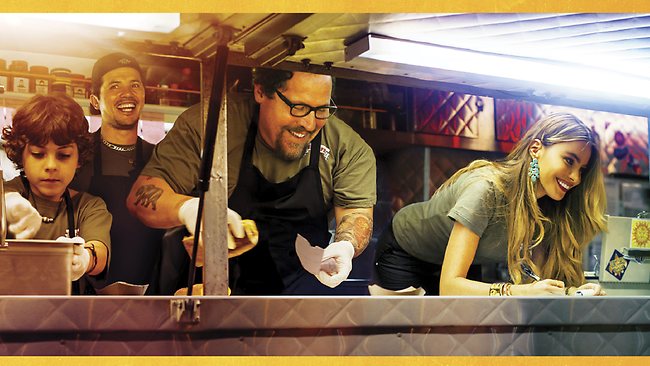
Chef


Chef is  Jon Favreau's baby. He wrote, produced, directed, and acted in his own movie. He basically had full creative control over this film and it is very impressive for anyone to accomplish such a task. Not only are you making creative decisions like where to put that light, but you are also making financial ones like how are we going to finance this project? what is our budget like? and on top of all that, he has to act, direct himself, his crew, and his cast. 
Mind is blow. Like, what? I don't think I could ever do something like that. So I applaud him for doing such a crazy thing. 
The movie shows the guy's passion for food. And that's inspiring. The film has a lot of heart and that's really good. 
For what it is, Chef is a good movie. Just something you put on and watch on a night where you don't want to think about anything and have an enjoyable experience. It is also a well done film and I would recommend it to anyone to watch. 

Waitress


Waitress has some story elements in common with Like Water for Chocolate, however I think the set up was better in the former. The idea that whatever this lady cooks makes people feel things is something they both share. 
The way they differ is the set up in act 1. Waitress did a better job at establishing the character, her role, her setting and her circumstance.  The film wasn't just about making pies, it was about life. It had a bigger picture than just 'a slice of life.'
I researched the film a little bit more after watching it, and learned that the writer/director, who also played Dawn in the film, died just a few months before the film was accepted into Sundance. That was really interesting to learn, and changed my perspective on the movie. 
To think that this was the last thing someone did before they died, was incredible. She defiantly went out with a piece that was very heartwarming and had a positive outlook on the future, something I think she could be very proud of. 


Julie and Julia


What makes this movie so good is Meryl Streep's performance. It is seriously so good. She embodies Julia Child so well. It was the saving grace that made all the other parts worth watching, just so you could get another scene with Meryl in it. 
I wish that it was a story just strictly on Julia, her relationship with her husband, and how she becomes 'The Julia Child.' That would have been so much more compelling to me than Julie and Julia. 
Julia's struggle from the beginning is fascinating. She is in a new city, and doesn't have anything to do. She finds she loves to cook and goes to school where she is brought down by her peers who doesn't think she's capable. Then the whole journey she takes to finally publishing her book -- this could have been a biopic and I would have loved it so much more. 
Meryl is a show stealer, and she defiantly lives up to her name as being one of the best actresses of this generation. 

Willy Wonka


When I was growing up, Willy Wonka and the Chocolate Factory was one of my favorite films. I don't really quite understand why, but it was. I watched it over and over and over again. Seeing it this semester brought back many nostalgic feelings for me. 
One of my favorite scenes in the film is the first time you see Willy Wonka. He comes out of the factory, limping. He then falls but tumbles out of it, smiling. What a great magic trick. He fooled everyone! The first thing he does sets up how he acts for the remainder of the film. As we soon find out, the whole golden ticket thing is a ploy to find someone to take over his factory. His greatest magic trick. 
I connected with the innocence of Charlie and I loved the relationship he had with his grandpa. It felt honest and loving. 
There were some differences from the book and the film, but I think the movie does a good job at capturing the spirit of the book. Most people think that just because a movie isn't exactly the same as a book that it's bad. Most of the time, a director is just trying to capture the spirit of what makes the book good and doesn't get caught up in the actual story because you could never tell a 500 paged story well in two hours.